
Why Can Mombasa Groundwater Be Salty?
Mombasa is a coastal environment, and groundwater conditions can differ considerably from inland locations. In coastal areas, groundwater may be affected by the geology, mineral composition of the aquifer and, in some locations, interaction with saline water. One important concern is saltwater intrusion. Saltwater intrusion occurs when saline water enters a freshwater aquifer. This can be influenced by factors such as groundwater extraction, aquifer characteristics, recharge conditions and proximity to the coast. However, not every salty borehole in Mombasa is necessarily experiencing the same problem. Groundwater chemistry varies from borehole to borehole. That is why the first step should always be water testing. Before purchasing a desalination or RO system, determine what is actually in the water.
Clear Water Does Not Mean Low-Salt Water
One of the biggest misconceptions about borehole water is that clear water must be good-quality water. Not necessarily. Water can be: Clear Odourless Free from visible sediment and still contain high concentrations of dissolved salts. You cannot reliably determine salinity simply by looking at the water. Laboratory analysis and measurements such as TDS and conductivity provide a much better indication of dissolved mineral content. Depending on the intended use, additional parameters may also need to be tested. These can include: pH Hardness Chloride Sulphate Sodium Calcium Magnesium Iron Manganese Silica Microbiological parameters Other site-specific contaminants The treatment system should then be designed around those results.
Why a Normal Water Filter May Not Remove Salt
This is where many property owners make an expensive mistake. A conventional sediment filter can remove suspended particles. A multimedia filter can help reduce certain suspended solids and turbidity. Activated carbon can address certain organic compounds, chlorine and taste or odour concerns. A water softener can reduce hardness caused primarily by calcium and magnesium. But these technologies are not interchangeable with desalination. Dissolved salts require a different treatment approach. If your primary problem is high salinity or high dissolved solids, installing a basic sediment filter and expecting the water to become low-TDS water is unlikely to solve the problem. This is why understanding the difference between filtration, softening and desalination matters.
Reverse Osmosis: A Different Approach to Salty Water
Reverse osmosis is one of the most widely used membrane processes for reducing dissolved salts from water. In an RO system, water is pressurized and passed across a semipermeable membrane. The membrane allows water to pass through while rejecting a substantial proportion of dissolved salts and other contaminants. The result is: Feed water → RO membrane → Permeate + Concentrate The treated water is called permeate. The concentrated stream containing a higher proportion of rejected dissolved substances is commonly called concentrate or reject water. For salty groundwater, RO can therefore be a much more appropriate treatment technology than conventional filtration alone.
But You Shouldn't Put Salty Borehole Water Directly Into an RO System
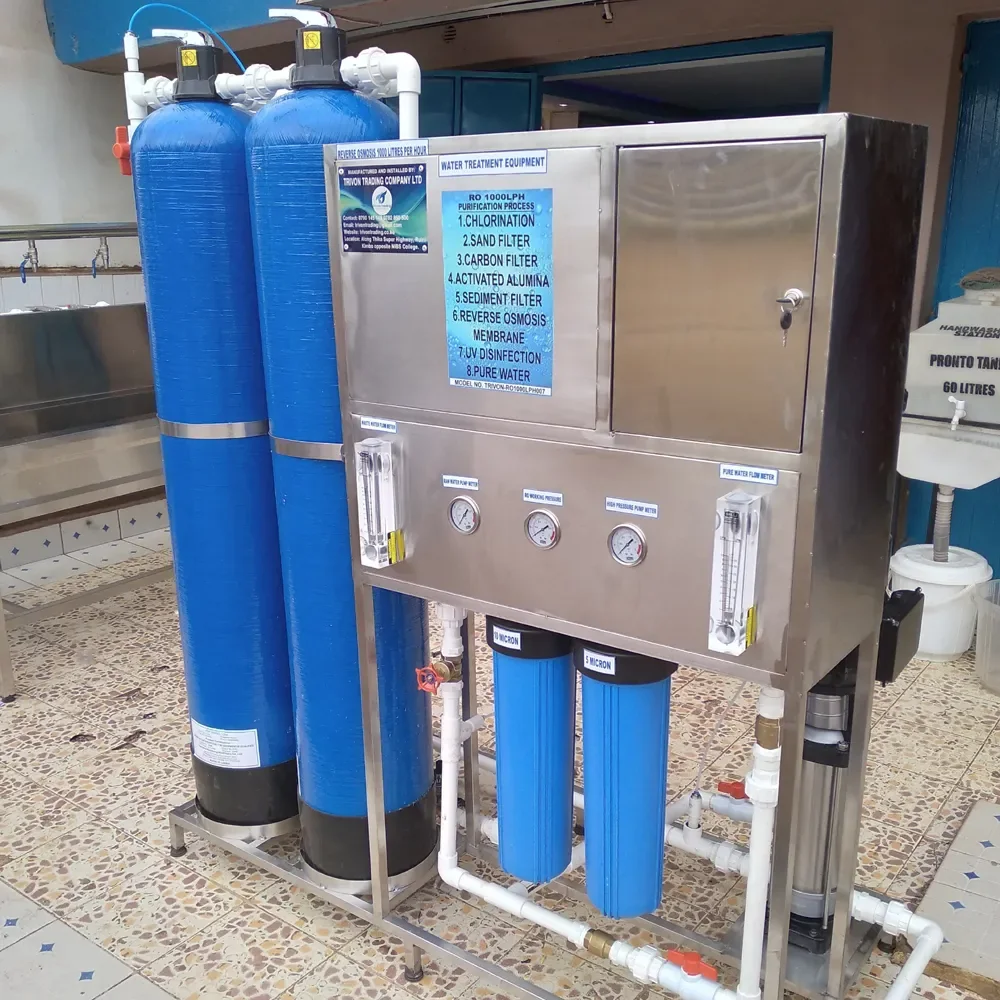
This is another important point. Reverse osmosis membranes are powerful, but they still require appropriate protection. Raw borehole water may contain: Sand Sediment Iron Manganese Hardness Microorganisms Organic matter Other contaminants Some of these can contribute to membrane fouling or scaling. A properly designed RO system may therefore require pretreatment before the water reaches the membrane. A typical system could look something like: Borehole → Feed Pump → Pretreatment → Cartridge Filtration → High-Pressure Pump → RO Membranes → Permeate Storage The exact configuration depends on the water analysis.
What Pretreatment Might Be Required?
There is no universal pretreatment package for every Mombasa borehole. The treatment requirements depend on the actual water chemistry. Sediment and Multimedia Filtration If the borehole contains suspended solids, appropriate filtration can reduce the particle load reaching downstream equipment. Iron and Manganese Removal If laboratory testing identifies elevated iron or manganese, specialized treatment may be necessary. Water Softening Where hardness is high and scaling is a concern, softening may be considered as part of the pretreatment strategy. Activated Carbon Activated carbon can be useful for certain applications and contaminants, but it should not be treated as a general-purpose salt removal technology. Cartridge Filtration Cartridge filters can provide finer particulate protection before the RO membranes. Antiscalant Dosing Depending on the feed-water chemistry and RO operating conditions, antiscalant dosing may be considered to help control membrane scaling. The important principle is simple: Pretreatment should be designed around the water analysis
What Happens If You Ignore High Salinity?
For domestic applications, users may notice: Salty taste Poor water quality Scale Staining Problems with appliances For hotels and hospitality businesses, poor water quality can affect guest experience and increase maintenance requirements. For industrial facilities, the consequences can be considerably more serious. High dissolved solids can affect processes involving: Boilers Cooling systems Manufacturing Food processing Cleaning Pharmaceutical production Laboratories Other applications requiring controlled water quality In these environments, water quality isn't simply a convenience. It can be part of the production process.
Why High-TDS Water Can Be Expensive
A common mistake is looking only at the cost of treating water. The more important question is: What does untreated water cost the business? High-mineral water can contribute to scaling and equipment maintenance. Depending on the application, this can result in: More frequent cleaning Increased maintenance Reduced equipment efficiency Higher chemical consumption Shorter equipment life Production interruptions A properly designed treatment system can therefore be viewed as part of protecting the wider water infrastructure.
Mombasa Boreholes Need Water Testing Before Equipment Selection
There is no responsible way to specify a desalination system based only on the statement: "The borehole water is salty." How salty? What else is in the water? What flow rate is required? What quality of water is needed? What is the source water temperature? What is the required recovery? What contaminants could affect membrane performance? These questions matter. For example, a small residential application and a hotel requiring tens of thousands of litres per day will need very different system designs. An industrial facility requiring process water may have even more stringent requirements.
How Much RO Capacity Do You Need?
RO systems are available in different capacities. The correct size depends on the required water demand and operating schedule. For example, you may need to determine: Daily water demand Peak demand Required permeate flow Storage capacity Operating hours Feed-water availability Required water quality Choosing a system that is too small can result in insufficient treated water. Choosing one that is unnecessarily large can increase capital and operating costs. For this reason, system sizing should be based on actual demand rather than simply choosing the largest RO system available.
What About RO Recovery?
Another important consideration in desalination is recovery. Not all feed water becomes permeate. Part of the feed stream leaves as concentrate. The appropriate recovery depends on factors including: Feed-water chemistry Scaling potential Membrane configuration Required permeate quality Operating pressure Pretreatment System design Trying to maximize recovery without considering water chemistry can increase scaling risk and compromise membrane performance. A well-designed system balances treated-water production with reliable operation
What Happens to the RO Reject Water?
RO produces a concentrate stream. This should be considered during system design. The appropriate management method depends on the site, regulations, water chemistry and application. Possible approaches may include suitable discharge, controlled collection, reuse where technically appropriate or another approved disposal method. The concentrate should not simply be treated as an afterthought. For coastal properties and industrial facilities in Mombasa, concentrate management should be considered during the planning stage of a desalination project.
Is Reverse Osmosis the Same as Desalination?
Reverse osmosis is one of the technologies used for desalination. Desalination generally refers to the process of reducing salts and other dissolved substances in saline or brackish water to produce water suitable for the intended application. RO is widely used because it can achieve substantial salt removal without relying on thermal evaporation. However, the appropriate technology and configuration depend on the source water and required output. For many brackish groundwater applications, a properly designed RO system can be an effective approach.
Can a Water Softener Remove Salt From Mombasa Borehole Water?
This is a common question. A conventional water softener is designed primarily to address hardness ions such as calcium and magnesium. It should not be confused with a desalination system. If your main concern is overall salinity or high TDS, a softener alone may not produce the required water quality. The correct treatment depends on the laboratory analysis. A system may use softening as pretreatment before RO when the water chemistry makes it appropriate.
How to Protect an RO System in a Coastal Environment
Once an RO system has been installed, maintenance becomes critical. Regularly monitor parameters such as: Feed pressure Permeate pressure Permeate flow Concentrate flow Feed TDS Permeate TDS Conductivity Temperature Differential pressure Tracking these values over time helps identify changes in membrane performance. A decline in permeate flow or an increase in permeate TDS can indicate that the system needs investigation. Potential causes include: Membrane fouling Scaling Changes in feed-water quality Incorrect operating conditions Pretreatment problems Membrane ageing Early intervention can prevent a relatively small performance problem from becoming a major system failure.
Common Mistakes When Treating Salty Borehole Water
Mistake 1: Buying a Filter Without Testing the Water The filter may not address the actual contaminant. Mistake 2: Assuming Clear Water Is Safe or Low-TDS Dissolved salts are invisible. Mistake 3: Installing RO Without Adequate Pretreatment Poor pretreatment can shorten membrane life. Mistake 4: Choosing RO Capacity Based Only on Borehole Yield Water demand and required permeate production must also be considered. Mistake 5: Ignoring Reject-Water Management Concentrate disposal should be considered during system design. Mistake 6: Focusing Only on the Purchase Price The cheapest RO system may not be the cheapest system to operate. Energy consumption, membrane replacement, cleaning, filters and maintenance all contribute to lifecycle cost.
Continue The Conversation
RFQ
RFQ
Request a QuoteHow to Choose an RO System for a Mombasa Borehole
Before purchasing an industrial or commercial RO system, consider these questions: What is your source-water quality? Start with laboratory testing. How much water do you need? Calculate daily and peak requirements. What quality does the final water need to meet? Domestic, hospitality, industrial and process applications can have very different requirements. What pretreatment is necessary? Design the pretreatment around the feed-water chemistry. How will the system be maintained? Consider membrane cleaning, cartridge replacement, monitoring and servicing. What happens to the concentrate? Plan for reject-water management before installation. What is the total cost of ownership? Look beyond the purchase price. Consider: Electricity Membranes Filters Chemicals Cleaning Maintenance Water consumption Downtime
Need a Borehole Desalination or RO System in Mombasa?
If your borehole water has high TDS, elevated salinity or other dissolved contaminants, Vortexus Industrial can help you assess the appropriate water treatment approach. Explore Vortexus Industrial's Reverse Osmosis Systems for solutions designed around commercial and industrial water treatment requirements. Whether you operate a hotel, apartment complex, factory, commercial property or other facility in Mombasa, the right system should be based on your water analysis, required capacity and final water-quality requirements.