
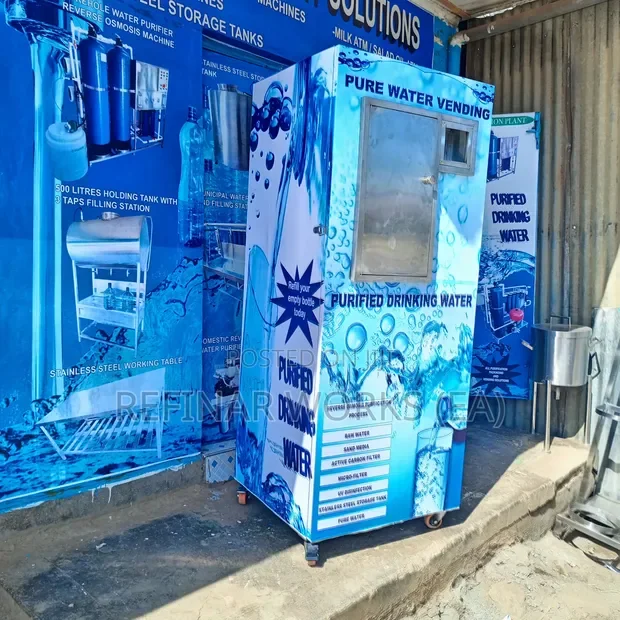
A water vending machine, also known as a water ATM, water vending ATM or water refill machine, combines water purification and controlled dispensing to allow customers to purchase purified water by volume. For a water refilling station, estate, apartment complex, school, hospital, commercial centre or high-traffic location, the right water vending system can make selling purified water more convenient and easier to manage. However, not every water vending machine is the same. The purification technology, dispensing capacity, payment system, storage arrangement, construction materials, maintenance requirements and after-sales support can all affect the long-term value of the machine. This guide explains everything you should consider before buying a water vending machine in Kenya.
What Is a Water Vending Machine?
A water vending machine is an automated or semi-automated system that dispenses a measured quantity of treated or purified water after a customer makes a payment or enters a dispensing command. Depending on the design, customers may pay using: M-Pesa Mobile payment Coins Cash through an attendant Keypad-controlled dispensing Other electronic payment methods A modern water vending machine can therefore combine several technologies: Water treatment + pumping + flow measurement + payment + automated dispensing. The machine can be installed as part of a water refilling station or integrated into a larger water purification business.
Water Vending Machine vs Water ATM
You may see different names when searching online. These include: Water vending machine Water ATM Water vending ATM Water refill machine Water dispensing machine Water refilling station machine Purified water vending machine In the Kenyan market, these terms are often used interchangeably. The important thing is not the name. The important question is what the equipment actually does. A good system should provide controlled dispensing and should be matched to an appropriate water treatment process for the source water.
Continue The Conversation
ASK FOR GUIDANCE
ASK FOR GUIDANE
Request a QuoteWater Vending Machines in Kenya: How Do They Work?
The basic process is straightforward. A typical system works like this: Water Source → Filtration/Purification → Treated Water Storage → Pump → Flow Meter → Payment/Control System → Dispensing Nozzle → Customer Container Depending on the system, some treatment stages may be integrated directly into the vending cabinet while larger water businesses may have a separate treatment plant feeding the vending machine. A customer brings a container, selects or pays for a quantity of water, and the system dispenses the required volume. For example, a vending system may be configured to dispense water according to the amount paid. The exact payment and dispensing mechanism depends on the machine configuration.
Why Are Water Vending Machines Becoming Popular in Kenya?
The water vending model solves a simple problem: Customers need affordable access to treated drinking water close to where they live or work. Instead of buying large quantities of bottled water, customers can bring their own containers and refill them. This can be particularly useful in: Residential estates Apartment buildings Informal settlements Town centres Shopping centres Schools Hospitals Institutions Offices High-density residential areas Water refill shops For entrepreneurs, a water vending machine can also provide a relatively simple way to automate part of the dispensing process. But location remains critical. A good machine in a poor location can perform worse than a basic machine in a location with strong demand
Types of Water Vending Machines in Kenya
Water vending machines can be categorized in several ways.
1. Single-Tap Water Vending Machines
1. Single-Tap Water Vending Machines A single-tap machine is suitable for smaller water vending operations or locations with moderate demand. It can be appropriate where the entrepreneur wants to start with a relatively compact setup. The main advantage is simplicity.
2. Multi-Tap Water Vending Machines
Multi-tap systems have multiple dispensing points. They can be useful in busy water refilling stations where several customers may need to fill containers around the same time. The number of taps should be selected according to expected customer traffic. Adding more taps does not automatically make a machine more profitable. The important consideration is whether your location has enough demand to justify the additional capacity.
3. Wall-Mounted Water Vending Machines
Wall-mounted designs can save floor space and may be suitable for compact premises.
They can be particularly useful where the available shop area is limited.
The installation must, however, account for plumbing, drainage, electrical supply, water storage and customer access.